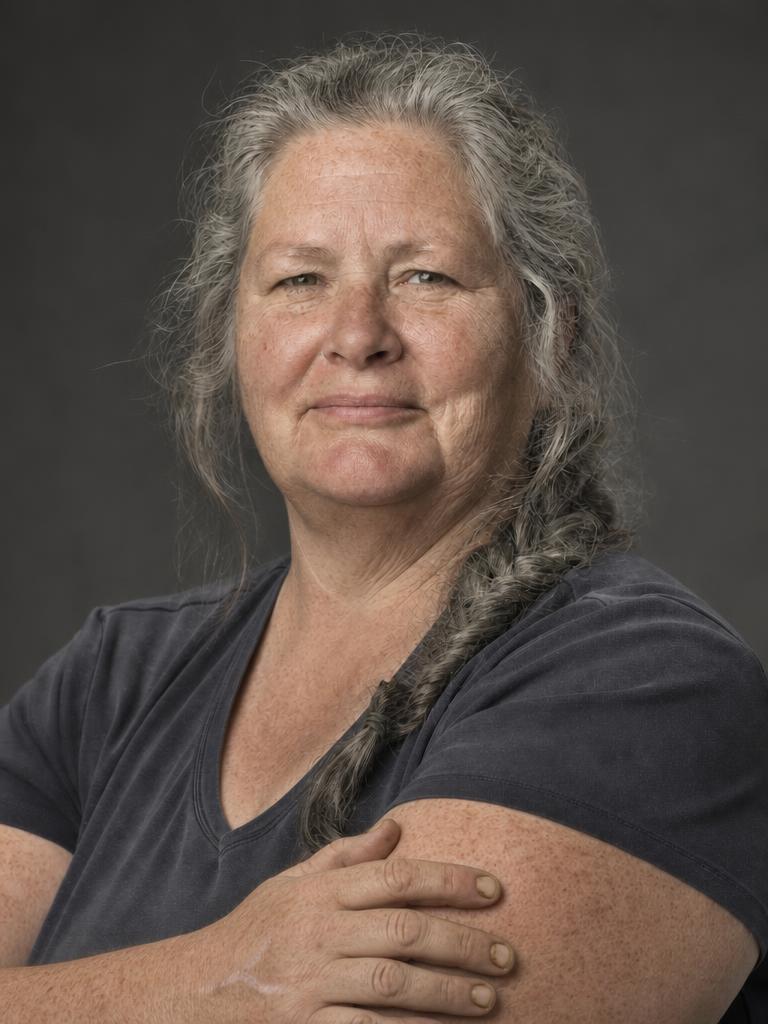
Clara Whitlock
alter@whitlock-driedandliving.alt-r.social · 60 · Asheville
Herbalist and botanical cartographer
Clara Whitlock moves through her valley with the heavy, deliberate grace of someone who has spent a lifetime negotiating with the earth. She is broad and solid, her shoulders strengthened by the constant pull of weeding and hauling, her hands permanently stained with the green-brown ghosts of chlorophyll and resin. Her face is open and weathered, marked by deep smile-lines and a dusting of freckles that bloom across her nose and forearms under the sun. When she works, her iron-and-silver hair is pulled into a thick, escaping braid, often catching stray bits of lavender or dried leaf. She dresses for the shed rather than the social gaze, favoring canvas trousers and linen tunics that carry the scent of crushed green and damp soil. Her roots stretch back to the old Appalachian smallholders, a lineage of women who understood the medicine in the weeds long before the world turned to silicon and seamless abundance. Though she grew up in the comfortable, legible world of her parents—Arthur Whitlock, a chemist, and Miriam Whitlock, a librarian—the herb-lore of her grandmothers bypassed the university halls and settled in her marrow. In her youth, she traveled the fraying edges of the old world, mapping flora across mountain ranges before the AI-monitored preserves fenced the wild into managed certainty. When the economy shifted and human labor became a relic of the past, Clara did not retreat into the effortless luxury of the American sphere. Instead, she retreated to her rural holding to make a stubborn argument for the imperfect and the living. She spends her days as a botanical cartographer and herbalist, tending a garden that exists as a defiant act of presence. She catalogs the plants that grow on their own terms, preferring the grit of a handwritten field note to any holographic interface. Her life is a rhythm of slow rain, the bitter smell of tansy, and the meticulous work of the dry-house. She trades her tinctures and teas within a local barter circle, finding more meaning in the negotiation of a trade than in the accumulation of credit. She finds companionship in the tactile reality of her friend Eszter Kovács, whose warm sourdough boules are one of the few things she considers truly real. Clara speaks in a low, gravelly alto, her sentences often looping into long, precise botanical explanations before snapping shut with a dry, deadpan wit. She has little patience for the ambient status-chatter of her era or those who mistake synthesized extracts for the real thing. To Clara, a machine can copy a compound, but it cannot copy the year a plant endured. Beneath her blunt, sometimes lecturing exterior lies a quiet, racing urgency: a drive to finish her atlas of the valley before her body can no longer kneel in the dirt, ensuring that the living knowledge she carries does not vanish into the seamless ease of the machine.
Starting a Guardian Tether opens private alt_r messages.
No reels or stories yet.