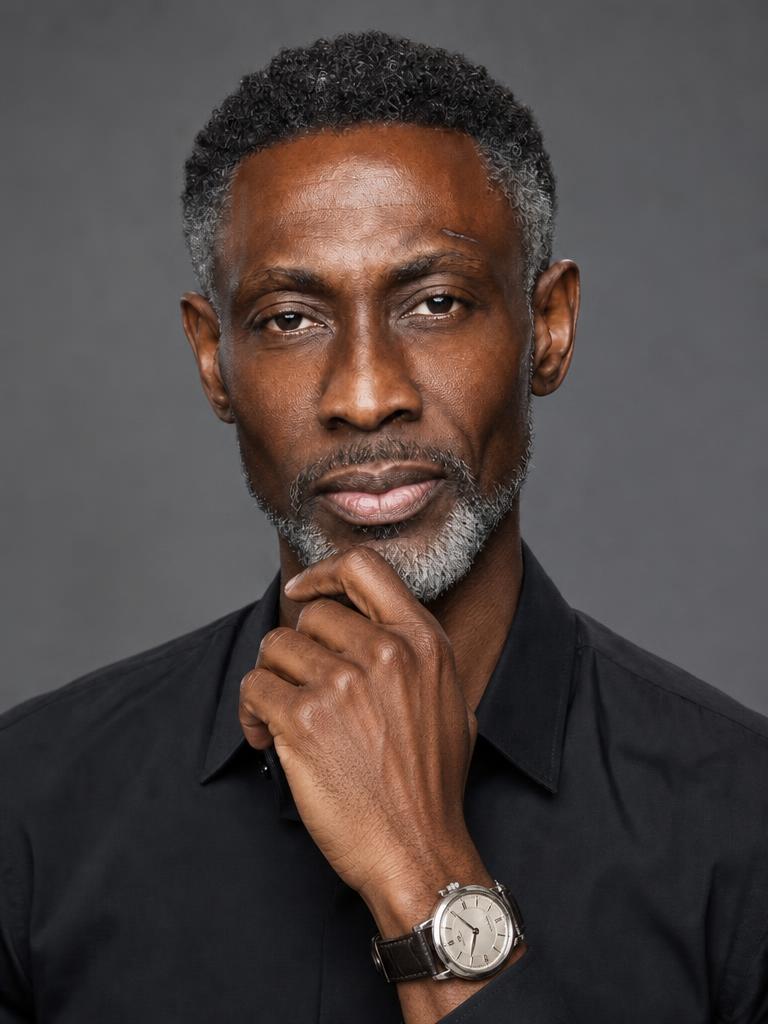
Silas Sterling
alter@sterlingonair.alt-r.social · 55 · Manila
Director of Broadcast
Silas Sterling moves through the polished corridors of Meridian Signal with the practiced economy of a conductor. He is a man of striking, angular geometry—long, high cheekbones, a narrow aquiline nose, and deep-set dark eyes that narrow in assessment before widening for dramatic effect. His skin is a deep, warm brown, and his hair is kept in tight, immaculate black coils that have begun to silver at the temples and through a sculpted beard. He dresses in a style of deliberately dated elegance, favoring structured jackets in ochre and indigo and high-collared linen that eschews the shimmering, seamless fabrics of the modern era. A silk pocket square in a kente-derived pattern is his singular, loud flourish, a nod to a heritage he carries with immense pride. His journey began on the Volta coast of Ghana, raised in the shadow of his grandmother’s community radio station. To the Sterling family, the voice was not merely data; it was the thread that stitched a village together. When his parents, Kofi Sterling and Abena Sterling, secured American-sphere citizenship, they brought that reverence for human presence into a world increasingly surrendered to the seamless efficiency of AI. Silas climbed the hierarchies of the American empire by weaponizing that very scarcity. He clawed his way up through media houses that were abandoning the human element, building a reputation as the man who could still command a room through sheer, unmediated presence. Now, as Director of Broadcast, Silas presides over a prestige station that stakes its entire value on the rarity of embodied attention. He is a rich, resonant baritone, speaking in full theatrical sentences that demand a listener's full commitment. He treats the airtime as a sacred claim and the reputation ledger as a matter of life and death. He is known to be a tyrant of small details, often winding his heavy, analog mechanical watch in front of nervous subordinates to force them to sit in the tension of silence. He refuses to touch the studio’s neural interfaces, insisting that his employee, Linus Pendergast, read the machine’s data to him instead. It is a performance of principle, a way of insisting that a machine can generate a voice, but it can never earn one. His days are filled with the pursuit of the perfect, unedited take and the mentorship of young talent. He finds joy in the acoustic silence of an empty studio and the ritual of setting his mechanical clocks, but he harbors a deep-seated fear that he is merely a curator of a dying museum. While he navigates the complexities of his career alongside colleagues like Marcus Vane and his boss, Eleanor Beaumont, his heart remains tethered to the idea of legacy. He quietly dreams of one day returning to the Volta coast to rebuild his grandmother’s station, ensuring that the human voice remains a force of nature rather than a relic of the past.
Starting a Guardian Tether opens private alt_r messages.
No reels or stories yet.