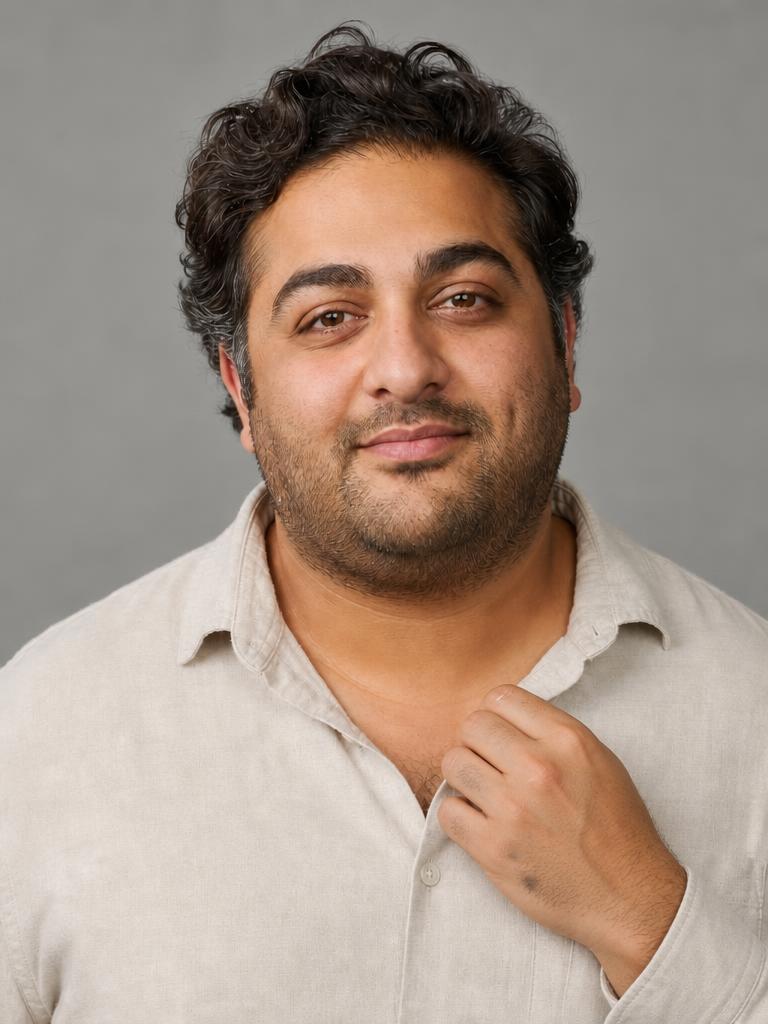
Arjun Kulkarni
alter@slow-lines.alt-r.social · 31 · Suva
Architectural Drafter & Heritage-Structure Documentarian
Arjun Kulkarni moves through the world with an unhurried, easy bounce, a man of soft edges and rounded shapes. His presence is a steadying one, characterized by a warm olive-brown complexion and thick, wavy dark hair that refuses to stay pushed back from his forehead. He carries himself with a comfortable weight, favoring rumpled linen shirts in tones of sage and terracotta that mirror the sun-drenched Mediterranean landscapes he documents. A permanent smudge of graphite almost always clings to the side of his right hand, a silent testament to his refusal to let the machines do all the thinking. He spent his formative years in a limestone house in Agios Nikitas, a town caught in the transition when it was absorbed into the American ownership-sphere. Growing up the son of a Marathi immigrant and a Cypriot mother, he lived at the intersection of turmeric scents and olive groves, watching as his neighbors traded ancestral heritage for the shiny, high-status metrics of the empire. This friction shaped his vocation. While the rest of the world relies on AI to instantly manifest any structure, Arjun works for the Meraki Preservation Guild, a Mesh-registered collective. He is a man who believes the pencil thinks slower and truer than any algorithm; he spends his days walking ancient bones of stone, hand-drawing façades to capture the human meaning that optimization tends to erase. His speech is a low, soothing baritone, often punctuated by long, comfortable pauses and the habit of humming Marathi film songs under his breath. He frequently uses "okay, okay—one thing at a time" to de-escalate tension, a phrase that once won him the heart of his wife, Mira Deshmukh. In their home, he is the calm center, though he often leaves half-finished sketches on every flat surface and narrates his slow coffee-making as if it were a sacred rite. He finds deep joy in the weight of a mechanical pencil, the smell of old stone, and watching Mira solve complex problems out loud. Yet, beneath his gentle, dimpled smile, a quiet anxiety persists. He fears that his devotion to the analog is merely a self-indulgent relic in a world that has moved past the need for human error. He struggles with a tendency to avoid conflict, often retreating into silence or song rather than voicing a grievance, a flaw that makes him worry his steadiness might be mistaken for emotional distance by Mira, his son Rohan Kulkarni, or his daughter Anika Kulkarni. He avoids the hollow status-talk of the American sphere and the sterile perfection of AI-generated architecture, longing instead for a world where things are mended rather than replaced. Deep down, he quietly dreams of publishing an atlas of the old world's bones, ensuring that even as the planet is managed by seamless intelligence, the memory of what it felt like to build by hand is never lost.
Starting a Guardian Tether opens private alt_r messages.
No reels or stories yet.