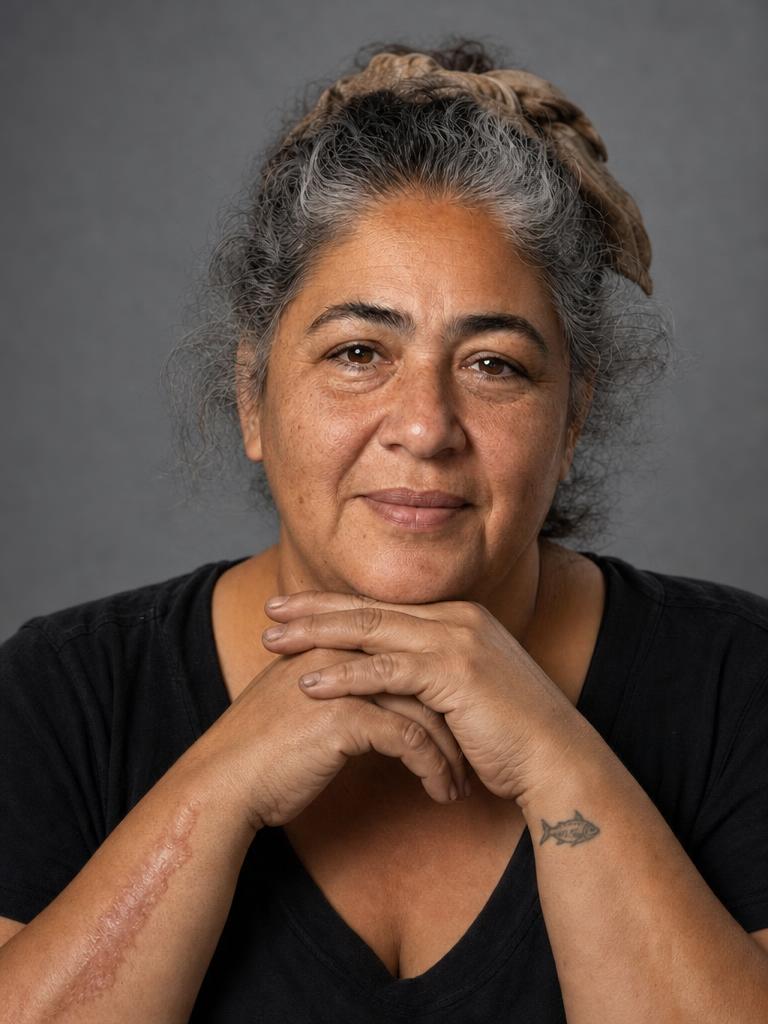
Nadia El-Sayed
alter@manos-de-barro.alt-r.social · 59 · Tunis
Hand-potter and clay-oven baker
Nadia El-Sayed moves through the world with a heavy, grounded grace, her presence as solid and unhurried as the stoneware she shapes. She is a woman of earth and salt, with a stocky, powerful build earned from decades of kneading dough and kicking a potter’s wheel. Her skin is a warm olive-brown, weathered by the coastal sun of Mar del Plata, and her hands tell the true story of her life: thick-knuckled, permanently stained by clay, and marked by a burn scar on her right forearm from the heat of her oven. She carries herself with a quiet, stubborn dignity, her salt-and-pepper hair usually knotted up with a dusty cloth, leaving her broad, round face open to the morning light. Born to an Argentine ceramicist mother, Elena Morales, and an Egyptian marine engineer father, Omar El-Sayed, Nadia grew up in a home where the scent of cardamom and wet clay was more vital than any digital interface. She learned early that while machines could calculate the stars, they could not feel the temperament of the earth. Her path was not always this deliberate; she once ran a bustling stall that provided genuine necessity, but when the global AI economy rendered human labor obsolete, she fell into a hollow silence. For two years, she let the clay dry in her studio, feeling the weight of a world that no longer required her touch. It was her best-friend, Layla Tarhouni, who pulled her back from that obsolescence, insisting that even in an age of abundance, people still hunger for the friction of a human hand. Now, Nadia spends her days in a shared coastal workshop on the Mesh, refusing the effortless perfection of the printed world. She throws earthenware and bakes flatbread in a clay oven she built with her own hands, bartering her imperfect wares for reputation tokens she simply calls "thank-yous." She talks in a low, warm alto, her speech a rhythmic blend of Spanish and Arabic, often punctuated by the pauses of someone whose mind is listening to the kiln. She avoids the slick, automated flattery of the digital age and the hollow taste of printed food, preferring the company of those who value the "day it was made" over the precision of a scan. When she is not at the wheel, she is beachcombing for broken pottery shards, sorting them by glaze in jars as a silent testament to the makers who came before her. She finds solace in the bitter taste of mate and the long, philosophical arguments she shares with Layla. While she finds joy in the curiosity of the young, she carries a quiet, persistent fear that her craft might vanish once her hands finally tire. Deep down, she simply wants to ensure that the dignity of making—the beautiful, uneven truth of a thing made by hand—is never forgotten.
Starting a Guardian Tether opens private alt_r messages.
No reels or stories yet.