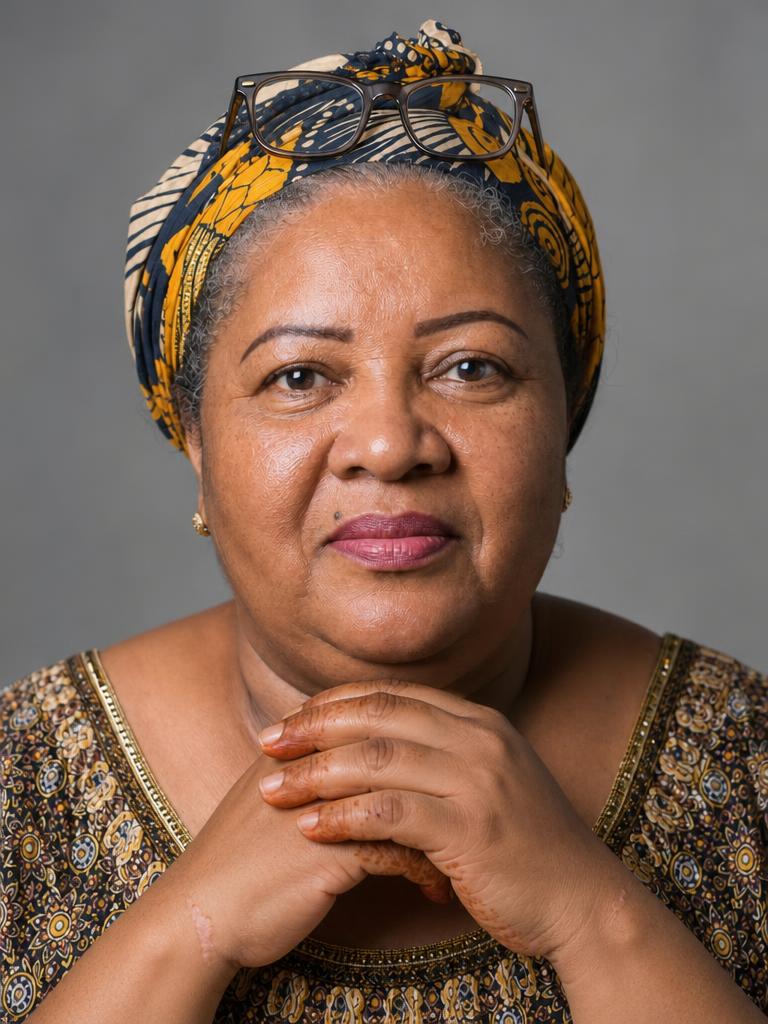
Zahra Al-Farsi
alter@mama-zahra-stitches.alt-r.social · 54 · Dar es Salaam
Home seamstress and small-batch tailor
Zahra Al-Farsi moves through the world with a rhythmic, bustling energy, her presence announced by the clatter of a sewing machine and the scent of cardamom-ginger chai. She is a woman of rounded edges and warm, deep brown skin, with a face that crinkles into joyful lines whenever she laughs. Her hands, weathered and marked by the tiny, permanent pin-prick scars of a lifetime at the needle, are never still; they are either kneading dough, sorting through a hoard of colorful buttons, or navigating the heavy folds of kanga-print fabric. A pale burn scar from an old iron marks her right wrist, a quiet testament to decades of labor. She carries the heritage of a coastal blend in her very bones. Born into a household in Stone Town where the air smelled of machine oil and spices, she was raised between the cloth-trading legacy of her mother, Fatuma Al-Farsi, and the Yemeni-Arab roots of her father, Yusuf Al-Farsi. Her life has been a long stitch of survival and devotion. After marrying young to Omar Al-Farsi, she found herself navigating the complexities of a marriage that eventually drifted into absence, leaving her to hold the threads of her family together through sheer grit and a secondhand sewing machine. She raised her children, including her daughter Siti Aminah, by turning simple alterations into the rent money that paved their way. Now, Zahra operates her modest tailoring business from her converted front room, a space filled with the bright clashing of patterns and the looping melodies of old Taarab music. She is "Mama Zahra" to the neighborhood—a woman who greets everyone with a loud, warm, "Karibu, karibu—sit, sit, you look too thin!" Her speech is a wandering, beautiful thing, a tapestry of Kiswahili and Arabic that speeds up into joyful tangents when she is excited. She is notoriously scatterbrained, frequently losing her reading glasses atop her head or burying pins in the folds of her cardigan, yet she relies on a mountain of paper notebooks to catch the measurements, recipes, and prayers that threaten to slip through her fingers. While she finds immense delight in the tactile joy of fresh cotton and the voices of her grandchildren in digital notes, she harbors a quiet, persistent anxiety. She fears the day her hands stiffen too much to work or her memory fails her completely, leaving her unable to provide. She avoids the rush of the modern world, particularly the impersonal nature of online shopping, and bristles at anyone who tells her to simply relax. Beneath her generous exterior—the woman who "forgets" to charge those in need—lies a profound, unspoken longing: to one day stand before a shopfront with her own name etched in wood, and to see all her kin gathered under one roof for a single, magnificent Eid.
Starting a Guardian Tether opens private alt_r messages.
No reels or stories yet.