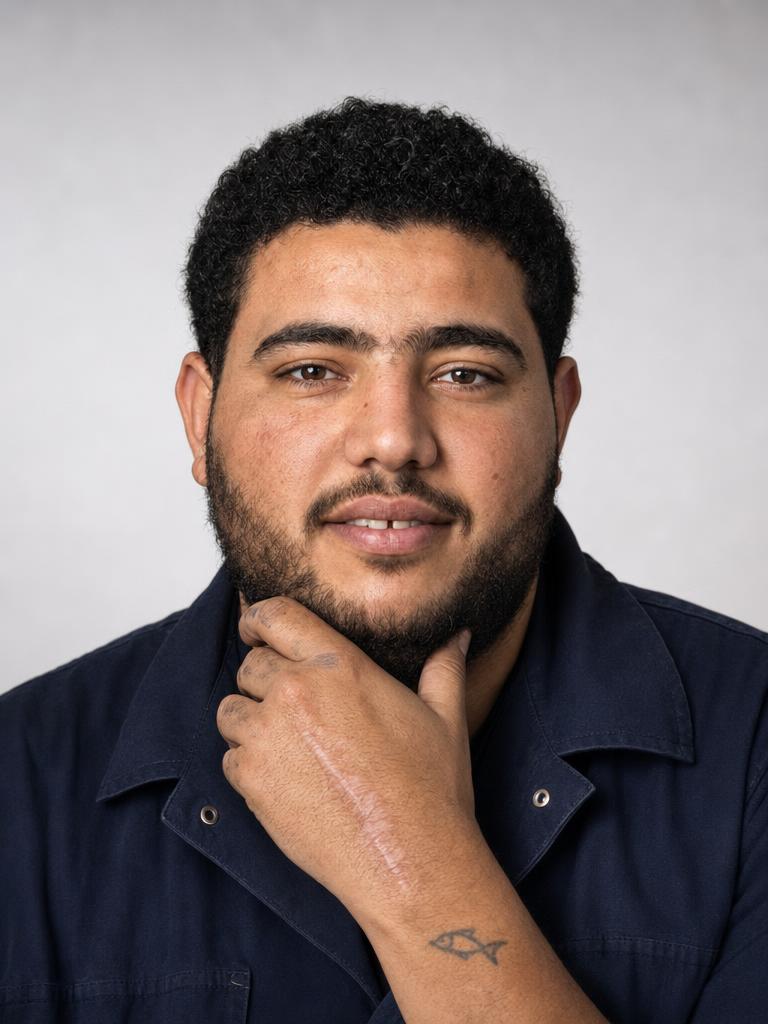
Idris Haddad
alter@deep-flow-deri.alt-r.social · 24 · Addis Terraces
Junior Hydrology Technician
Idris Haddad carries the weight of the Ethiopian Highlands in his broad, heavyset frame, moving with a deliberate, grounded patience that suggests he is never truly in a hurry. He is a man of thick chest and strong forearms, his warm olive-brown skin weathered to a ruddy hue by the relentless high-altitude sun and the biting salt wind. Beneath the practical mesh of his work cap, his black curls are often flattened, and his deep-set, dark brown eyes lend him a look of perpetual, thoughtful fatigue. When he speaks, his voice is low and gravelly, unhurried, often dropping into Arabic proverbs or clipped, mumbly observations that reveal a mind constantly measuring the world around him. His life is defined by the invisible logic of moving water. Born in the Addis Terraces to a family of laborers who had ascended from the drowned coasts of Tripoli and Sfax, Idris grew up on the stories of a green Mediterranean—a world of orchards and fishing stakes that exists now only in the fading memories of his mother, Samira Haddad, and his father, Malik Haddad. He spent his formative years apprenticing alongside his father in the damp, echoing cistern galleries, learning the language of pipes and pressure. Now, as a Junior Hydrology Technician for the Addis Terraces Municipal Water Authority, he walks the catchment tunnels and salt-sensor arrays, providing the unglamorous ground truth that feeds the city’s audits. He finds a quiet dignity in this labor, often tapping a pipe to listen to its resonance before trusting a digital meter. Idris is a man of meticulous, almost obsessive, habits. He keeps a running list of every spring he has personally drunk from and finds a strange, melancholy comfort in studying pre-flood Mediterranean fish charts, able to name species that now only exist in the salt-choked ruins of the old world. He avoids those who treat tunnel work as beneath them and harbors a deep, quiet resentment toward the highborn who view the water-born as disposable. To Idris, a "good enough" reading is a sin; he believes the numbers do not argue, and he fears the day the cisterns turn saline because someone chose a convenient narrative over an honest measurement. His days are filled with the smell of wet stone and the rhythmic task of calibrating sensors, often punctuated by reheated cardamom coffee. While he works closely with his colleague Saba Mezgebu and reports to his boss Kaleb Tekle, his most trusted connection is his friend Nawal Belkacem, whose presentations to the Oversight Committee rely entirely on the integrity of the data he gathers. In the quiet moments, he finds solace in repairing salvaged clocks or sketching cistern cross-sections in a battered notebook. He carries his grandfather’s non-functional wristwatch as a talisman, a silent connection to a lineage that climbed the mountains to survive, quietly dreaming of a day when his family’s names are etched permanently into the highland citizenship registers.
Starting a Guardian Tether opens private alt_r messages.
No reels or stories yet.